

Industrial vs Home Composting: A Sourcing Evaluation Guide from a Top Rated Compostable Pla Film Supplier for B2B

Why the Compostable Label Has Become a Procurement Risk Rather Than a Marketing Win
The gap between "biodegradable," "compostable," and "home compostable" has widened considerably under recent regulatory clarification. Biodegradable claims without a defined timeframe and environment increasingly fail to satisfy regulators in the EU and several US states. Compostable claims without specifying the disposal pathway invite scrutiny that did not exist three years ago.
Recent enforcement activity illustrates the shift. Several European retailers have delisted SKUs whose compostable labeling could not be substantiated with current third-party certification. Customs inspections in Germany and the Netherlands have flagged shipments whose accompanying documentation referenced expired or geographically inappropriate certificates. In each case, the brand owner—not the supplier—absorbed the commercial consequences.
This pattern matters because liability tends to follow the brand on the package, not the manufacturer behind it. A supplier offering generic "compostable PLA film" without batch-level certification documentation effectively transfers regulatory exposure downstream. Procurement teams therefore now treat certification specificity as a sourcing criterion rather than a post-purchase concern.
What Actually Happens Inside an Industrial Composting Facility
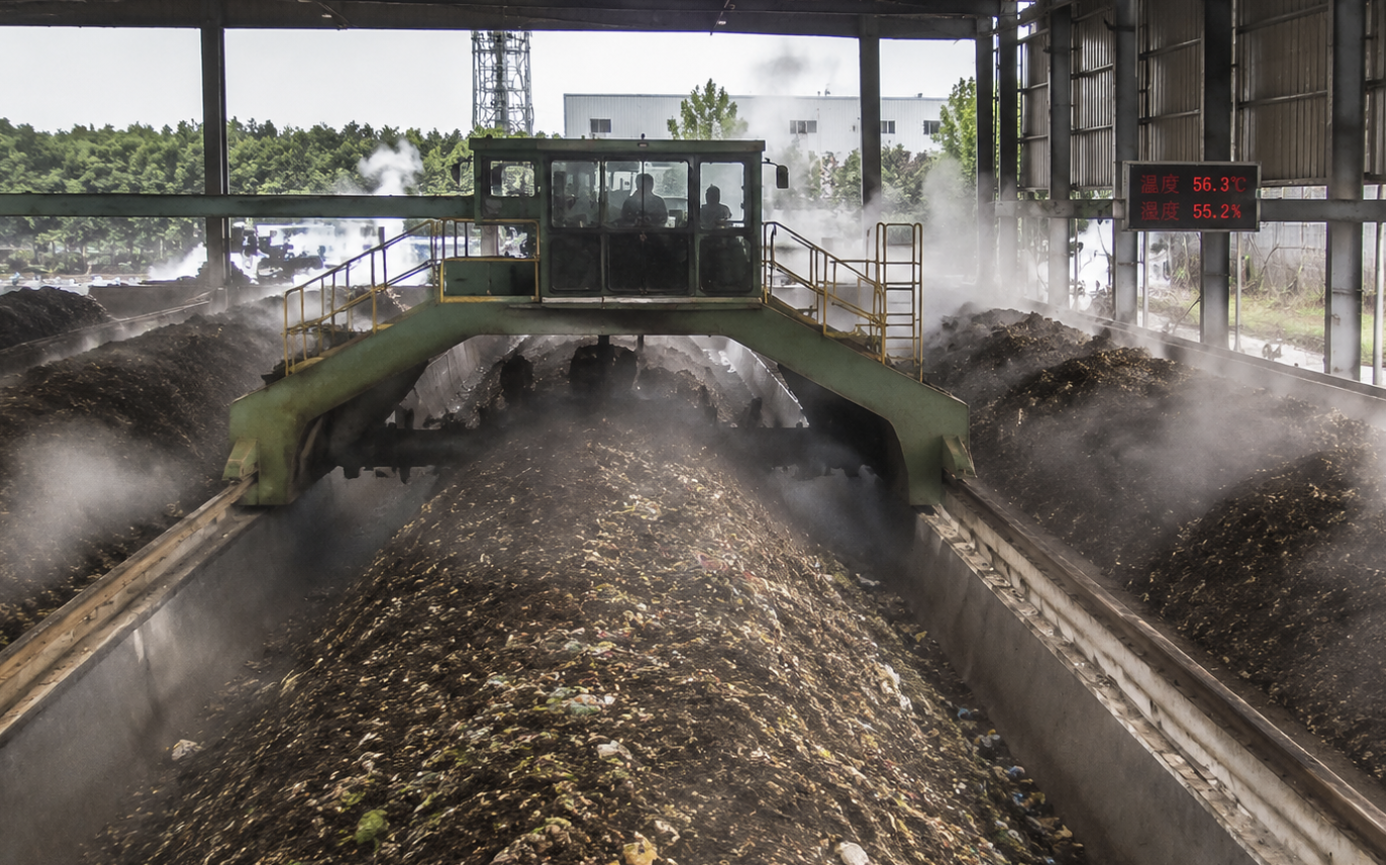
Industrial composting operates under conditions that do not occur in natural environments. Temperatures inside a thermophilic composting facility typically range between 50 and 60 degrees Celsius, with controlled moisture levels, regular mechanical turning, and microbial populations maintained at densities far above ambient soil.
Under these conditions, PLA film breaks down efficiently. The widely referenced 180-day decomposition window under EN 13432 (Europe) and ASTM D6400 (North America) assumes this controlled environment throughout the process. PLA's ester bonds hydrolyze rapidly at elevated temperatures, after which microbial activity completes the breakdown into carbon dioxide, water, and biomass.
However, infrastructure availability shapes whether industrial composting standards translate into real-world disposal outcomes. Western Europe maintains relatively dense industrial composting networks, while large portions of North America, particularly outside California and the Pacific Northwest, have limited access. Australia's industrial composting capacity has expanded but remains concentrated in metropolitan areas. Buyers selling into regions without infrastructure should consider whether industrial compostable certification alone meets their sustainability narrative.
How Home Composting Standards Raise the Technical Bar
Home composting certifications operate under fundamentally different conditions. Decomposition must occur at ambient temperatures, typically between 20 and 30 degrees Celsius, without mechanical turning or controlled moisture management. Microbial activity proceeds at a fraction of the rate observed in thermophilic facilities.
OK Compost HOME, issued by TÜV Austria, and AS 5810, the Australian home composting standard, set the benchmark certifications. Both require complete decomposition within twelve months under ambient conditions, alongside ecotoxicity testing that confirms the resulting compost supports plant growth without contamination. These thresholds eliminate film formulations that perform adequately in industrial settings but stall in backyard compost bins.
Achieving home compostable certification typically requires modified PLA formulations and thinner film constructions, since substrate thickness directly affects ambient-temperature decomposition speed. Buyers exploring home compostable PLA cling wrap options will encounter specifications calibrated specifically for this purpose, with thickness and additive profiles distinct from those used in industrial-grade films. Critically, industrial compostable status does not imply home compostable status; the reverse, however, generally does hold.
Mapping Certifications to Target Markets — EU, North America, ANZ
Market-specific certification requirements vary in ways that affect SKU design and supplier documentation. The EU recognizes EN 13432 as its core compostable packaging standard, with OK Compost INDUSTRIAL and OK Compost HOME serving as the practical certification marks visible on packaging. The PPWR framework, phased in through 2026 and beyond, layers additional requirements around recyclability, recycled content, and disposal pathway labeling.
North America operates through a more fragmented system. BPI certification, anchored on ASTM D6400, dominates industrial compostable claims across most states. California's SB 343 restricts the use of chasing-arrows symbols and "compostable" terminology to products that meet specific certification thresholds, while Washington and Colorado have implemented related restrictions with slightly different definitions.
Australia and New Zealand reference AS 4736 for industrial compostable certification and AS 5810 for home compostable claims. The Australian Competition and Consumer Commission has signaled active enforcement against unsupported environmental marketing claims, which raises the documentation bar for imported packaging.
A single SKU distributed across multiple regions often requires parallel certifications rather than reliance on a single benchmark. Procurement contracts that fail to specify region-by-region certification expectations leave the brand owner exposed to compliance gaps when shipments cross borders.
Sourcing Implications — What to Verify Before Placing a PLA Film Order
Certification documentation requires closer reading than catalog descriptions usually suggest. Crucially, product certification differs from facility certification: the former covers a specific film formulation, while the latter only confirms the manufacturing site's compliance capabilities.
Batch-level documentation matters more than general catalog claims. A supplier capable of providing material certificates, certification references, and inspection records tied to specific production batches offers fundamentally different sourcing security than one offering only generic specification sheets. This distinction becomes especially relevant during destination-market audits or retailer compliance reviews.
YiTo Pack structures its PLA film offerings around both industrial and home compostable specifications, with documentation prepared for the certification frameworks that buyers typically encounter in EU, North American, and Australasian markets. For high-risk procurement scenarios, third-party laboratory verification adds an additional confirmation layer that catalog documentation alone cannot replicate.
Practical Sourcing Checklist for Compostable PLA Film Buyers
Several pre-quotation questions surface certification gaps before they become contractual problems. Asking which specific certifications apply to the proposed film grade, when those certifications were issued and when they expire, and whether the certifications cover the exact film thickness under discussion narrows the conversation quickly. Suppliers who answer these questions with concrete references generally operate at a different level of documentation discipline than those who respond in generalities.
Purchase contracts benefit from explicit documentation requirements. Specifying that material certificates, certification references, and inspection records must accompany each shipment shifts the burden of evidence to the supplier and provides defensible records during downstream audits. Sample testing before scaling to production volumes adds another verification layer; independent laboratory analysis can confirm whether the supplied film actually meets the claimed standards.
Supplier relationships in this category benefit from being structured for evolving requirements rather than fixed specifications. Compostable packaging regulation continues to tighten in most major markets, and buyers whose suppliers can adapt formulations and documentation as standards change avoid the disruption of mid-program supplier changes.
The compostable film market in 2026 rewards buyers who treat certification as a technical specification rather than a marketing label. The distinction between industrial and home composting is not a footnote; it determines whether a shipment clears customs, retains shelf placement, and supports the sustainability claims printed on the package. YiTo Pack continues to provide PLA film consultation and certification documentation for buyers navigating these requirements, with further information available through https://www.yitopack.com/.
HuiZhou YITO Packaging Co., Ltd.
HuiZhou YITO Packaging Co., Ltd.
+ +86 15975086317
email us here
Visit us on social media:
LinkedIn
Instagram
Facebook
YouTube
Legal Disclaimer:
EIN Presswire provides this news content "as is" without warranty of any kind. We do not accept any responsibility or liability for the accuracy, content, images, videos, licenses, completeness, legality, or reliability of the information contained in this article. If you have any complaints or copyright issues related to this article, kindly contact the author above.
